You have children in the house. You’ve decluttered and organized your items to suit your space, not your stuff, but you are frustrated with getting them to follow the new system. Sound familiar?
Here are the three likely problems that are happening and how to solve them:
- They have limited beliefs about being organized. They model after us, so if you say things like, I’m just no good at it, I’ll never do it right, or I can’t, those words will become their inner critic. Do yourself a favour and start saying it out loud; I thought I couldn’t, but now it’s easier to manage; and I feel more confident; I can do this.
- There is still too much stuff to manage. It’s our job to set them up for success. You can be a good organizer and have all the containers to do so, but if it’s too complicated of a system and everything is jam-packed, you’ll fall behind. It’s time to remove even more.
- Past habits are interfering with the present. It takes time and practice to develop a new habit. Please remind your child of their successes in the past. You didn’t know how to ride a bike without training wheels, but after a year of practicing, you did, and you feel proud. Be gentle with the process and trust that it will happen. If it’s been 3 to 6 months and it’s still a major struggle, go through #1 and #2 again, then consider changing the organizing system to suit your lifestyle.
Keep in mind that most children and adults are visual learners and they can’t meet our expectations if we don’t teach them.
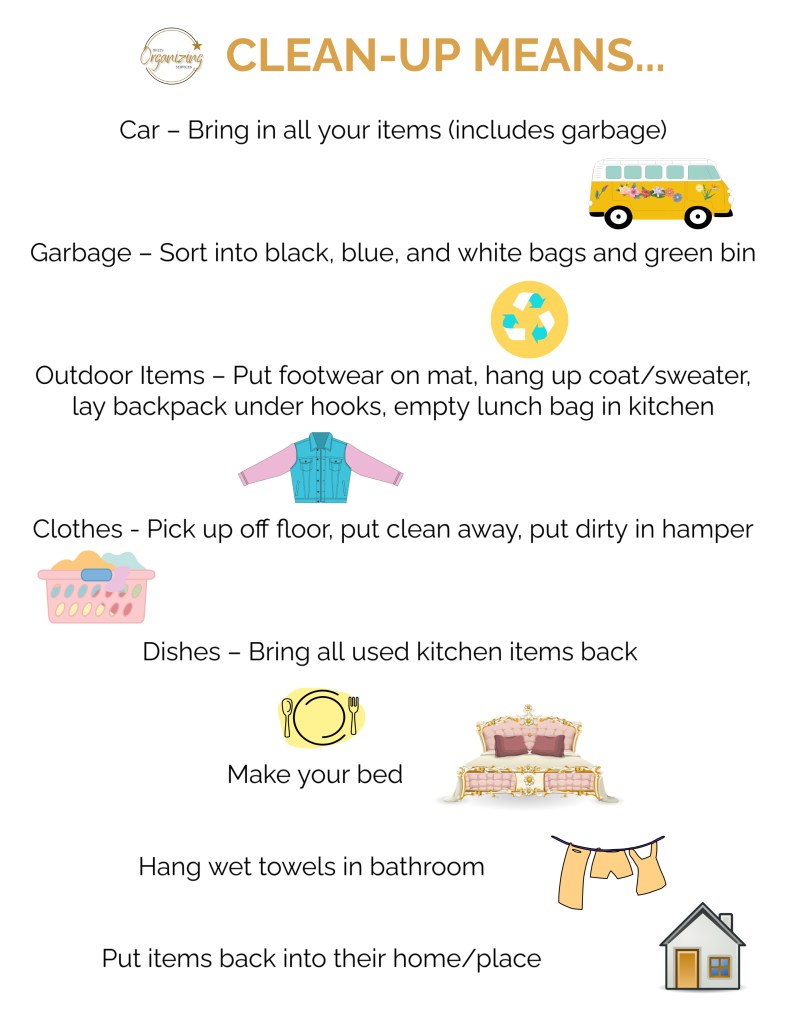
I created a poster for my children, so I don’t have to repeat myself or raise my voice when they don’t listen when I say it’s time to “Clean-Up.” Here I have my own at home expectations typed out for my oldest, and I’ve included photos for my youngest. Feel free to download, print, and post on the wall for your child or create one of your own that’s customizable. To be clear, these are not chores so they don’t earn anything for taking good care of the items in our home.
Please remember, every child learns and processes information differently. Some may find organization more naturally appealing, while others may require more support due to diagnosed or undiagnosed conditions such as OCD, hoarding disorder, or pathological demand avoidance.
This can make finding the right approach a journey of trial and error. Be kind, patient, and consistent as you explore what works best for you and your child. Remember, there’s no one-size-fits-all solution, and fostering a positive learning environment is key. Keep calm and revisit
Want to create a culture of organization? It all starts with you! By modeling the behaviors you value and sharing your organizational wins, you inspire others and cultivate a positive, motivating space where everyone thrives.
 Trained Professional Organizer & ADHD Specialist