
Image Source: Amazon.ca
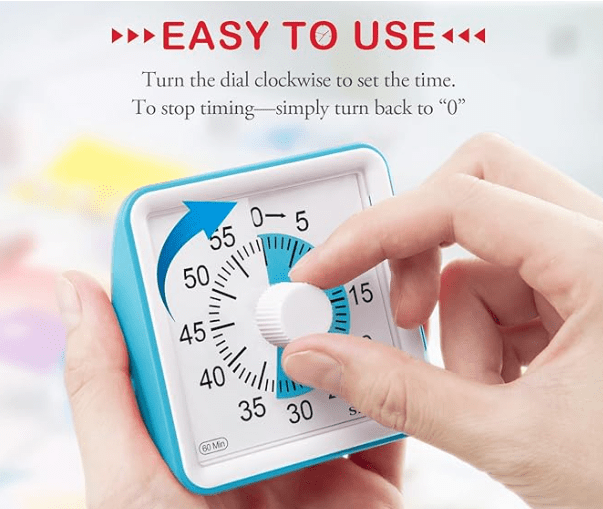
My top recommendation for individuals with brain-based challenges is to utilize an analog timer for focused 20-minute decluttering and organizing, followed by 5-minute breaks. Analog timers provide visual and intuitive time tracking that can be particularly helpful. Here is where to purchase one from Amazon.ca and below is a list of reasons why analog timers can be advantageous.
1. Visual Representation of Time:
- Concrete and Tangible: Unlike digital timers that present time as abstract numbers, analog timers offer a visual, spatial representation of time elapsing.1 You can see the hand moving or a colored disk disappearing, making the passage of time more concrete and easier to grasp.2
- “Time as a Quantity”: The pie-chart-like display of many analog timers (especially visual timers) helps the brain understand time as a finite quantity that is decreasing. This can be more intuitive than watching numbers change.
- Seeing the “Before” and “After”: An analog clock or timer shows the starting point, the current moment, and the time remaining all at once. This provides better context and a sense of how much time has passed and how much is left.
2. Enhanced Time Awareness:
- Improved Perception of Duration: Watching the continuous movement of the hand or the shrinking visual cue can improve your intuitive sense of how long a minute, 5 minutes, or longer actually feels. This can help combat “time blindness,” a common challenge for individuals with ADHD.
- Less Cognitive Load: With an analog timer, you often don’t need to perform mental calculations (like subtracting the current time from the end time) to understand how much time remains.3 This reduces cognitive effort, freeing up mental resources for the task at hand.
3. Reduced Distractions:
- Simpler Interface: Analog timers are typically less complex than digital ones with multiple buttons and settings. This simplicity can be less overwhelming and less likely to lead to distractions.
- No Screen to Get Lost In: Unlike digital timers on phones or computers, a dedicated analog timer won’t tempt you to check notifications, emails, or social media.
4. Can Aid Focus and Productivity:
- Visual Cue for Urgency: Seeing the time physically running out can create a gentle sense of urgency, helping you stay focused on the task.
- Easier Transitions: For tasks with time limits, the visual representation can make it easier to understand when it’s time to transition to the next activity.
5. Multisensory Engagement:
- Manual Operation: The act of physically setting the dial can also provide a more tactile and engaging experience.
In summary, analog timers can be best for some brains because they offer a more intuitive, visual, and less distracting way to perceive and manage time. This can be particularly helpful for individuals who struggle with the abstract nature of digital timekeeping and those who benefit from concrete visual aids.
However, it’s important to note that not everyone will find analog timers superior. Some individuals may prefer the precision and features of digital timers. The best timer ultimately depends on individual preferences and cognitive styles.
Footnotes and additional resources:
If you’d like help with a home or office decluttering and organizing project, please reach out through my Contact Us page.
 Trained Professional Organizer & ADHD Specialist